The Identification
of Pike by Means of Characteristic Marks
by
Neville
J. Fickling
ABSTRACT
The
markings of pike (Esox lucius L.) were found to be specific to individual
fish. The subsequent recapture of pike after 2 years of growth, indicated that
the markings could be used for the positive identification of specific pike.
INTRODUCTION
Marking or tagging studies have frequently been employed
to study the movement and growth of a variety of fish species. A variety of tag
types, subcutaneous dye injections, fin clips and freeze brands have been used
with success in such studies. It is however, unfortunately true that many tag
types will retard growth (De Roche, 1963; Christensen, 1961; Eschmeyer, 1959;
Shetter, 1967). Tags are also prone to loss due to either removal by natural causes
or by anglers. Mutilation caused by fin clipping is not acceptable in many fisheries,
while freeze branding demands constant access to a supply of liquid nitrogen.
This is obviously impractical for small scale studies. Dye marks are generally
satisfactory, but restricted in application, due to the limited number of permutations
available for the identification of the individual. It is suggested that the markings
of the pike (Esox lucius L.) are very specific for individual fish and
a method of identification of individual pike by these markings is described.
METHODS
One-hundred and eighty-seven photographs of pike were examined (length 838-1118
mm; age 5-14 years), Eighteen individuals were photographed from both sides enabling
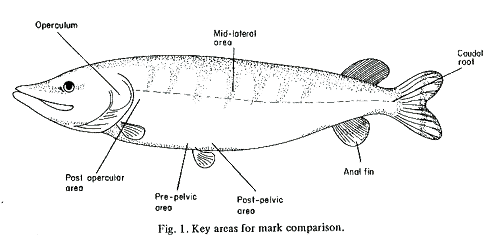
comparison between sides. Key areas were selected on the flanks of the pike, these
areas being those where markings were distinct and easily examined. One area of
fin was also selected as a key area. These key areas are identified in Fig. 1,
Initially the markings of individual pike were compared, one side against the
other.
The criteria of similarity was noted as
when three key areas showed similarity, between pike being compared. In practice
when three key areas were found to be similar, all other key areas were also similar.
Comparison of the two sides of a pike showed that the markings, though similar
in size and shape, were not necessarily similar in position. It was therefore
concluded that comparisons of markings were only valid for pike photographed from
the same side. A standard method of photography was therefore employed. All pike
which were either hand held or laid on the ground were photographed with the head
of the pike facing the right of the picture. This was in effect, with the pike's
head facing left from the holder's point of view.
RESULTS
The photographs of 187 pike, all viewed from the same side
were then studied. The types of marking varied considerably depending on the origin
of the pike. Considerable differences in markings were also noticed in pike from
the same habitat. Three basic types of marking were noted, all typical of mature
pike (small pike tend to have transverse bar markings, which disappear with increasing
growth). These are shown in Fig. 2 and can be described as:
oval
spots;
round or stellate spots;
longitudinal bars.
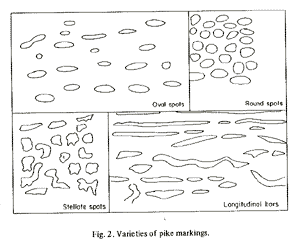
Oval
spots tend to vary in size, from 10 to 25 mm depending on the locality and size
of the pike. Round or stellate spots vary similarly. The longitudinal bar pattern
is very typical of pike of Irish Loughs. It is uncommon for pike to display more
than one pattern type in one particular environment. However, examples of all
three patterns have been noted by the present author in one of the Fenland Drains.
In
order to establish the unique nature of the markings of all the pike examined,
each were compared with each other. In no case was more than one key areas similar
between individual pike. Often the difference in spot pattern was enough to signify
`no similarity'.
A small number of pike were dye marked and photographed.
Recaptures of four different fish were made 2 years later. Each fish was found
to be similar on the basis of at least three key areas being comparable. This
indicated that the markings remain similar for at least two years. A large number
of other fish, (860-1120 min) which have been at liberty for up to one year were
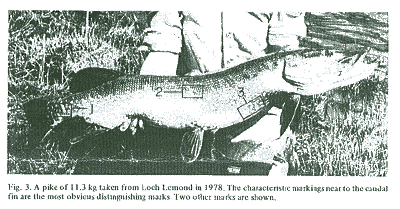
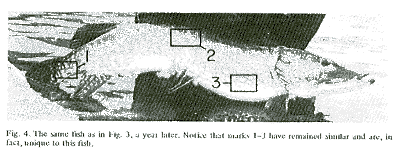
also found to retain the same markings. Figs 3 and 4 shows one such fish captured
from Loch Lomond (A.), on four occasions in 1978 and 1979. Figure 3 shows the
fish as captured in 1978 and Fig. 4 as captured in 1979. The caudal area of this
fish has particularly characteristic marks. Growth increments of dye marked pike
were up to a maximum length increment of 50 mm and weight increase of 2.75 kg.
Table 1 presents the weights, age & fork lengths of the four pike noted above.
TABLE
1. Weights, lengths and ages of four pike recaptured after 2 years
| Location |
Initial wt (kg) |
Initial l (mm) |
Initial age | Final
wt (kg) | Final I
(mm) |
| Loch
Lomond | 10.9 |
1092 | 12 | 11.8 |
1118 |
| River
Nar | 6.7 |
864 | 6 | 9.3 |
991 |
| Norfolk
Lake 1 | 8.4 |
991 | 9 | 10.4 |
1041 |
| Norfolk
Lake 2 | 7.4 |
914 | 8 | 9.8 |
995 |
DISCUSSION
The method of identifying individual pike requires the use
of photography, a relatively inexpensive method, easily available for the study
of pike. The method does not disfigure, mark or otherwise harm the fish-an important
point if the aesthetic qualities of catching and returning fish in good condition
are to be preserved. The method has been found to be suitable for the identification
of pike of 500 mm and larger which have shown percentage length increases of 5.4%
and percentage weight increases of 31.3% over a period of 2 years. Caution should
be shown when attempting to apply this method to very young pike. Rapid growth
results in the addition of more spots or marks and it is therefore likely that
the marks change beyond recognition. Pike are at present under a prolonged investigation,
with particular reference to changes in markings with growth. The result of this
study will be presented at a later date.
ACKNOWLEDGMENTS
I would
like to thank Mr D. Plummer for the photograph used in Fig. 3 and pike angling
friends who supplied photographs of pike.
REFERENCES
Christensen,
J.M. (1961) Survey of the Danish sole tagging experiments with notes on the growth
rate. Conseil permanent internationale pour I'Exploration de la Mer, 1961
Meeting Northern Seas Committee Paper, No 126 14pp..
De Roche,
S.E (1963) Slowed growth of lake trout following tagging. Transactions of the
American Fisheries Society, 92, 185-186.
Eschmeyer, P.H.
(1959) Survival and retention of tags, and growth of tagged trout in rearing ponds.
Progressive Fish Culturist, 21, 17-21.
Shetter, D.S.
(1967) Effects of jaw tags and fin exision upon growth, survival and exploitation
of hatchery rainbow trout fingerlings in Michigan. Transactions of the American
Fisheries Society, 394-399.